Balistic Tech

Project Overview
Ballistic Tech is an educational mobile game designed to teach younger users about historical computing and calculation devices through an arcade-style protection mechanic. The player protects important artifacts by moving them across an abacus-inspired game board while missiles fall from above. The goal is to keep the artifacts from being destroyed long enough for the user to understand their historical value.
The project connects game interaction with history education. Instead of presenting computing devices as static facts, Ballistic Tech turns them into objects the player must actively defend. If the player successfully protects a device, the game rewards them with information explaining how that artifact affected society. If the player fails, the game shows the negative impact of losing that artifact and what society might have missed without it.
Design Process
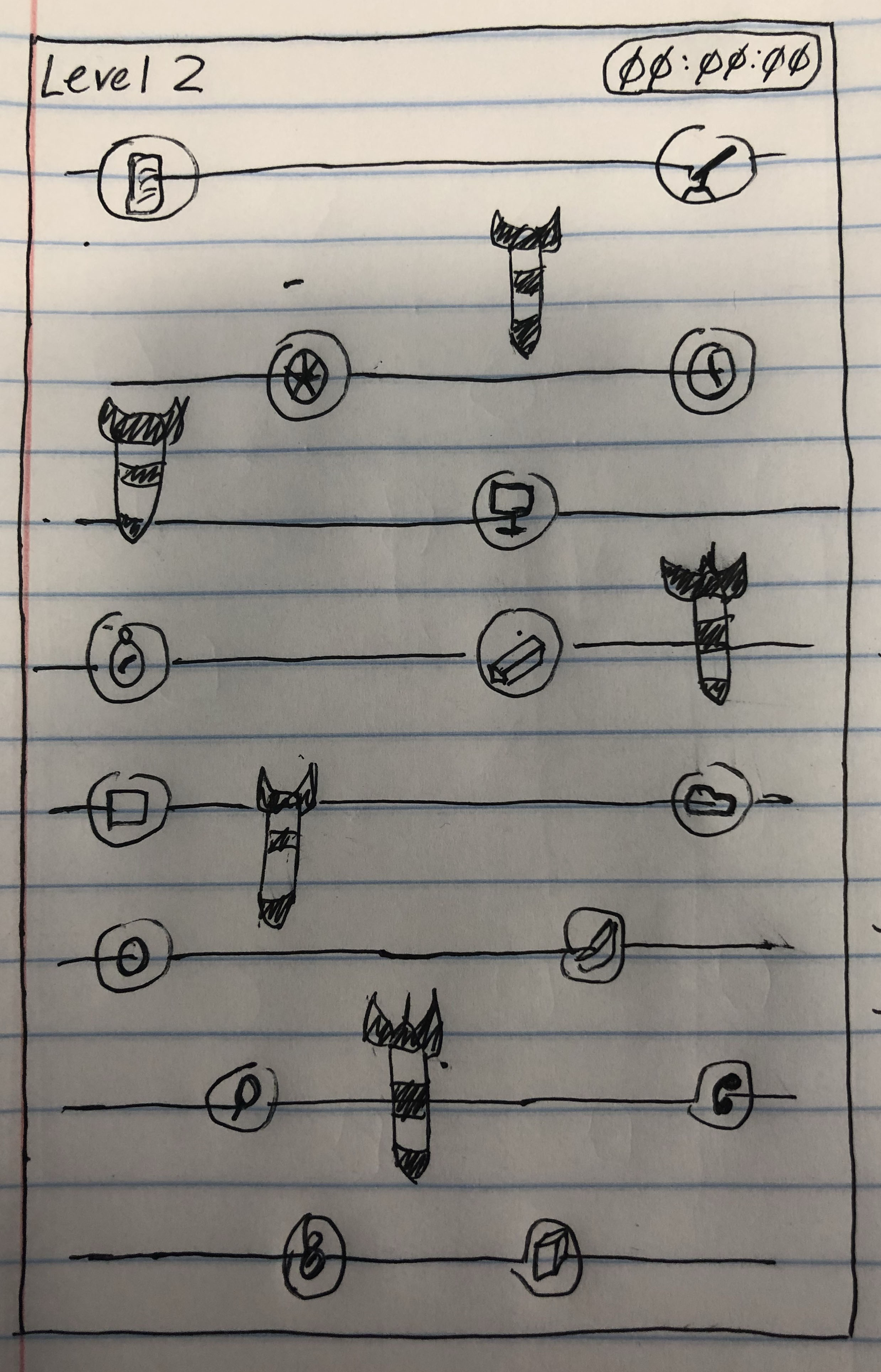
The design process began with early sketches that mapped out the core screen layout. The original concept included an abacus layout, falling ballistic missile vectors, movable artifact vectors, a level header, and a timer display. These sketches helped define the game’s main interaction: moving artifacts across horizontal abacus rows while avoiding incoming missiles.
The project was developed as a group assignment by Cody Camarasana, Ajani McIntosh, and Stephen Garafola. The broader class work focused on the history of interaction design, computing devices, and how older inventions influenced modern technology. Ballistic Tech built directly from that research by turning historical computing artifacts into playable game content.
Sketching the Interactions


Game Rules
The gameplay is structured around simple survival, movement, and scoring rules:
• Only one artifact can be moved at a time
• Survive 100 missiles and the missiles will move faster next round
• Gold Artifact - 20 points
• Purple - 10 points
• Blue Artifact - 5 points
• Green Artifact - 1 point
• If all gold artifacts survives a gold artifact replaces a green artifact in the next round
• The more gold artifacts the user has the higher the score the user has
Content Used
The game uses historical computing and calculation devices as its main educational content. The artifacts included:
• Astrolabe
• Abacus
• South Pointing Chariot
• Mechanical Computer
• Cray-1
• Pascal’s Calculator
Other Related Devices

Final Product
The final product presents Ballistic Tech as a mobile game with a warm orange visual style, abacus-like rows, falling missiles, artifact icons, level tracking, and a timer. The final screens show both gameplay and reward feedback. In one example, the player reaches Level 5, and the game presents a reward screen for the Thomas Arithmometer with the message: “Congratulations. You Earned Another Gold.”
The advertisement screen frames the game with the tagline “Collect and Protect your Tech” and presents it as an app-store-style mobile experience. This helped position the project as both a playable game and an educational product.
Final Takeaway
Ballistic Tech showed how historical research can be transformed into an interactive product. Instead of only explaining why old computing devices mattered, the game made users defend those devices through play. This made the learning experience more active and memorable.
The project also showed the value of working through ideas as a group. The final concept combined research, sketching, game mechanics, visual design, and educational content into one simple experience. As a limited case study, Ballistic Tech demonstrates an early understanding of how interaction design can make history feel playable, visual, and easier to understand.
Like (Love) My Work?
Contact me to discuss your case!
I am currently based in Long Island, NY.